 Greensboro
 Spring Pollen and Your AC Coil
Everything in Greensboro turns yellow for a few weeks each spring — including the inside of your condenser. Here is what that actually costs you, and how much of the fix is a homeowner job.
Pollen Turns Your Condenser Into a Blanket
An outdoor condenser works by moving air across a coil to dump heat outside. That means it spends its life pulling everything in your yard through itself — and in a Piedmont spring, that is an extraordinary quantity of pine pollen.
On its own, pollen would mostly blow through. The problem is that it combines with dust, grass clippings and the general grime of a working condenser to form a mat across the fins. Once that mat forms, the coil cannot shed heat properly. The system compensates the only way it can: by running longer.
You do not usually notice this as a failure. You notice it as a system that runs and runs on a July afternoon and never quite gets the house where you want it, and a power bill that crept up without explanation.
It Lands Right Before You Need the System
The seasonal sequence in Greensboro is genuinely unhelpful. Heavy pollen arrives in spring, while most people still have windows open and the air conditioning off. Nobody is watching the condenser, because nobody is using it.
Then the first properly hot week arrives, the system is asked for full output for the first time in months, and it is already working through a coating that has had weeks to bake on. That is why the first heat wave produces such a spike in calls — a good share of them are not sudden failures at all, but systems that have been quietly handicapped since April.
The same timing applies to the indoor side. A filter that spent spring catching pollen is restricting airflow before summer starts, and restricted airflow is a leading cause of frozen evaporator coils.
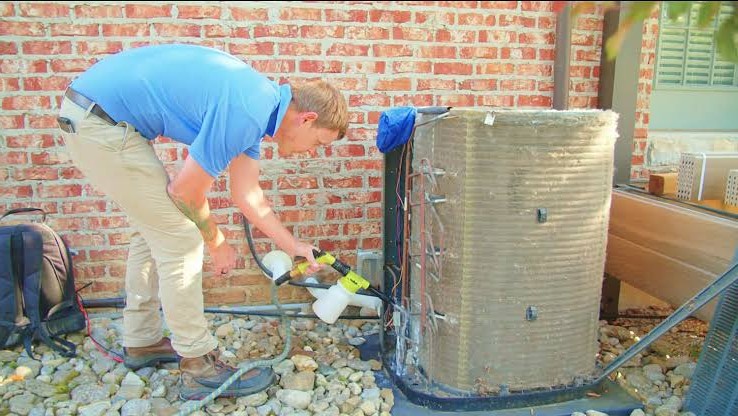
What You Can Safely Do Yourself
- Change the filter monthly through spring. The cheapest, highest-return maintenance there is. If it looks grey and matted, it has been restricting airflow for a while.
- Rinse the outdoor coil. Kill power at the disconnect first. Use a normal garden hose, spraying from the inside outward where you can reach, to push debris back out the way it came.
- Clear two feet around the unit. Shrubs, fence panels, stacked firewood and leaf piles all choke airflow. Growth creeps in over a season without anyone noticing.
- Keep clippings off it. Aim the mower discharge away. Grass clippings mat onto a damp coil almost as effectively as pollen.
- Watch for standing water. A settled pad that pools water invites corrosion and, in winter, ice.
- Do not use a pressure washer. It flattens the fins, and bent fins block airflow permanently. This is the most common way homeowners make things worse.
- Do not use household degreasers on the coil — some corrode aluminium fins.
- Do not open the cabinet to clean inside. There are capacitors in there that hold a charge with the power off.
What a Rinse Will Not Reach
A hose handles the surface. It does not touch the things that actually need instruments to assess, and it never reaches the indoor coil.
The evaporator coil sits inside the air handler on the indoor side, and in a humid climate it collects a damp film that traps everything the filter missed. It is not accessible without opening the unit, and it is where a fouled system does its quietest damage — reduced capacity, poor dehumidification, and a condensate pan that eventually overflows because the drain has bio-fouled.
A proper spring tune-up covers the coil chemically rather than mechanically, clears and treats the condensate drain, checks refrigerant charge and verifies that the system is actually delivering its rated airflow. In this climate the drain treatment alone earns its keep — algae grows fast in Triad humidity, and a blocked condensate line is one of the most common causes of water around an air handler.
If the ductwork has never been looked at, that is worth pricing at the same time. Leaky returns pull unfiltered air — and pollen — straight into the system from crawl spaces and attics, which undermines everything else you have just cleaned. The duct cleaning and sealing page covers what that involves.
And if the system is already showing symptoms — ice on the lines, warm air, short cycling — that is past maintenance and into AC repair territory.
Frequently Asked
Does pollen actually damage an air conditioner?
It does not damage it outright, but it insulates it. Pollen bonds with condenser dust and grime into a mat across the coil fins, and a coil that cannot shed heat forces the compressor to work harder and run longer. The result shows up as higher bills and shortened equipment life rather than a dramatic failure.
When is pollen season in Greensboro?
The heavy yellow pine pollen typically runs through spring, with tree pollen starting earlier and grass pollen following. The practical point for HVAC is that the worst of it lands right before the first serious cooling demand, so systems start summer already coated unless someone cleans them.
Can I clean the outdoor coil myself?
Rinsing the outdoor condenser with a garden hose is reasonable homeowner maintenance. Kill the power at the disconnect first, spray from the inside out where you can, and use normal hose pressure. Do not use a pressure washer — it bends the fins flat and makes the airflow problem permanently worse.
How often should I change my filter during pollen season?
Monthly is a sensible default through spring, and check it more often if you run the system hard or have pets. A filter that looks grey and matted is already restricting airflow, which is one of the most common causes of frozen coils and short cycling.
Will cleaning the coil actually lower my power bill?
It removes an avoidable penalty rather than delivering a dramatic saving. A fouled condenser forces longer run times to reach the same indoor temperature, so cleaning it returns the system to its designed efficiency. The larger benefit is usually reduced wear on the compressor over the summer.
Get Ahead of the First Heat Wave
Spring tune-ups book out fast once the weather turns. The line is answered 24/7.
Call (336) 555-0148