 Greensboro
 Heat Pump vs Gas Furnace in the North Carolina Piedmont
The honest answer depends on one thing most comparison articles skip: what fuel your house already has. Here is how the choice actually plays out in Greensboro, rather than in a national average.
The Piedmont Sits in the Heat Pump Sweet Spot
Most heat-pump-versus-furnace advice online is written for somewhere colder than here. It is aimed at Minnesota, or hedged so carefully for every climate that it tells you nothing. Greensboro is a genuinely different case.
Our heating season is long but mild. Weeks of 40s and 50s, punctuated by short cold snaps. That distribution matters enormously, because a heat pump's efficiency advantage is largest in exactly that mild band and shrinks as the temperature drops. A climate that spends most of its winter between 35 and 55 degrees is close to the ideal case for the technology.
That is why new construction across Guilford County ships with a heat pump on the pad as a default, and why the housing stock here is so heat-pump heavy compared with states a few hundred miles north.
Where Each One Actually Wins
A heat pump does not make heat. It moves heat that already exists in the outdoor air, which is why it can deliver two to three units of warmth per unit of electricity in mild weather. Resistance heat delivers exactly one. A gas furnace makes heat by burning fuel, and its efficiency is capped by combustion — a very good one converts about 96% of the fuel to heat, and it cannot exceed 100%.
So in the 40s and 50s, the heat pump is not close — it wins comfortably. As the temperature falls, its output drops and its advantage narrows. Somewhere in the 20s and 30s, depending on the equipment and the price of gas that year, the two converge.
The catch is that a standard heat pump handles the cold snap by firing electric backup strips, which are the most expensive heat in the house. A winter with several hard freezes can erase a lot of the savings from the mild weeks.
Start With What Your House Already Has
This is the part that actually decides it for most Greensboro homeowners, and it has very little to do with efficiency tables.
- No gas service today? Go heat pump. Running a new gas line purely to buy a furnace almost never pays back in this climate. A heat pump installation is the straightforward answer, and a cold-climate model removes the old objection about hard freezes.
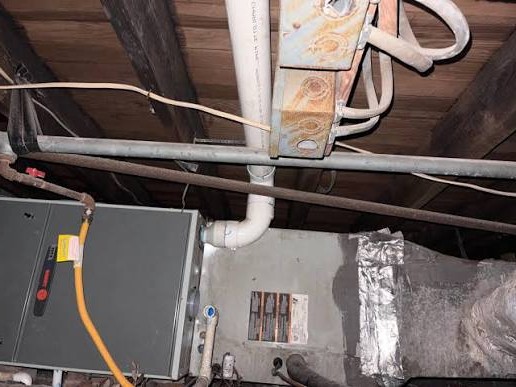
- Existing gas furnace still in good shape, AC dying? Replace the AC, keep the furnace. You already own the expensive half of a dual-fuel system.
- Both ends failing at once, gas already on site? This is the case for dual-fuel, and the one where it genuinely shines.
- All-electric home, older heat pump? Replace like for like, but look hard at a cold-climate model. The backup strips are where your January bill comes from.
- No ductwork at all? Different conversation entirely — see ductless mini-splits.
The Setup That Sidesteps the Argument
A dual-fuel system pairs a heat pump with a gas or propane furnace on shared ductwork. A control point — sometimes fixed, sometimes outdoor-temperature-sensing — decides which one runs. Heat pump for the mild 90% of a Piedmont winter, furnace for the arctic exception.
What you are really buying is the elimination of the electric backup strips. The furnace takes the job the strips would have done, at a fraction of the running cost. In a Greensboro winter that means you get the heat pump's efficiency across the long mild stretch and never take the expensive hit during the cold snap.
It is not free — you are maintaining two heat sources, and the install is more complex. But if you already have gas service and both halves of the system are due, the maths is often better than either option alone. It is genuinely common in Stokesdale and the outlying areas where propane is already on site.
Whichever route you take, the sizing matters more than the badge on the box. A correctly sized furnace or heat pump beats an oversized premium one every time, and oversizing is the single most common installation fault in this market.
Frequently Asked
Is a heat pump cheaper to run than gas heat in Greensboro?
For most of a Greensboro winter, yes. A heat pump moves two to three units of heat for every unit of electricity it consumes in mild weather, and the Piedmont spends most of its heating season in the 35 to 55 degree range where that advantage is largest. Gas closes the gap on the handful of nights that drop into the teens, which is exactly the case for a dual-fuel setup if you already have gas service.
Do I need a gas furnace at all in the North Carolina Piedmont?
Not necessarily. Plenty of Guilford County neighbourhoods never had gas lines run to them and heat perfectly well on heat pumps alone. If you have no gas service today, running a new line purely for heat is rarely worth it — a cold-climate heat pump handles Greensboro winters without the infrastructure cost.
What is a dual-fuel system?
A heat pump paired with a gas or propane furnace, sharing the same ductwork. The control system runs whichever is cheaper at the current outdoor temperature: the heat pump through the mild majority of winter, the furnace on the coldest mornings. You get the low operating cost of a heat pump without the backup heat strips ever running.
Will a heat pump keep my house warm when it drops into the teens?
A modern one will. Standard heat pumps lose capacity as temperature falls and lean on electric backup heat below roughly 30 to 35 degrees. Cold-climate models hold rated output well below 20 degrees, which covers essentially every night Greensboro sees. The failure mode people remember from 1990s heat pumps was undersized equipment plus resistance strips, not the technology itself.
Which is better for a home with no ductwork?
Neither, in the conventional sense — that is a case for ductless mini-splits, which are heat pumps without the duct requirement. They are common in older Greensboro and Jamestown homes, additions, and bonus rooms that the main system never reached properly.
Not Sure Which Way to Go?
Describe your setup — what you have now, whether you have gas, what is failing — and you will get a straight recommendation.
Call (336) 555-0148