 Greensboro
 Why Is My Heat Pump Icing Over in Winter?
Some frost is the system working exactly as designed. A block of ice is a fault. Here is how Greensboro homeowners can tell which one they are looking at — in about thirty seconds, from the back door.
Frost Is Normal. Ice Is Not.
Every heat pump in Guilford County frosts up in winter. It is not a defect — it is physics. The outdoor coil has to sit colder than the outside air to pull heat out of it, and when that coil drops below freezing on a damp Piedmont morning, the moisture in the air condenses onto it and freezes. The system expects this and clears it automatically.
The useful question is not is there ice on my heat pump. It is what kind of ice, and does it go away.
- Normal: a white frosty film on the back and sides of the coil, clearing every hour or so, gone entirely by mid-morning.
- Normal: steam rolling off the unit for a few minutes while it defrosts. People call about this constantly. It is just melted frost flashing to vapour.
- Not normal: clear solid ice you cannot see the coil fins through.
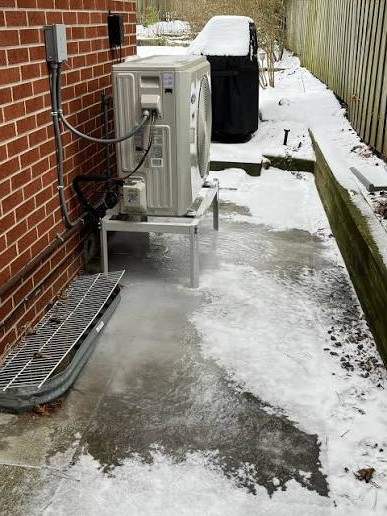
- Not normal: ice on the top of the cabinet, over the fan blades, or a sheet of it built up underneath the unit.
- Not normal: ice still there at 3pm on a 45°F afternoon.
Your Heat Pump Runs Its Own Air Conditioner in Reverse
When the control board decides the coil needs clearing, it briefly flips the system into cooling mode. Hot refrigerant runs out to the outdoor coil and melts the frost off from the inside. The outdoor fan shuts off so it is not blowing cold air across the coil it is trying to warm.
Meanwhile, so you are not blasted with cold air indoors, the auxiliary heat strips fire up to temper the supply air. That is why your electric bill has a spike shaped like January in it, and why a system stuck defrosting over and over gets expensive fast.
A healthy cycle: fan stops, whoosh from the reversing valve, 5 to 15 minutes of melting, fan restarts, back to heating. Every 30 to 90 minutes in genuinely cold, damp weather.
What Actually Causes the Bad Kind of Icing
When a Triad heat pump ices up solid, it is almost always one of five things:
- A failed defrost sensor or control board. The system never realises it needs to defrost, so frost just accumulates until the coil is a solid block. The single most common cause we see.
- A stuck reversing valve. The valve that flips the system into defrost mode does not move, so the cycle never actually happens even though the board calls for it.
- Low refrigerant. An undercharged system runs the coil colder than it should, frosting faster than defrost can keep up. There is no such thing as a system that "used some up" — low charge means a leak.
- Blocked airflow. Leaves packed against the coil, a shrub grown in too close, or a filthy indoor filter. Restricted air means the coil cannot pick up heat and drops below freezing.
- Standing water under the unit. If the pad has settled or the drainage is poor, defrost melt pools underneath and refreezes into a rink that grows up into the cabinet. Common on older Greensboro installs where the pad has sunk.
The last one is worth a look before you call anyone, because you can sometimes fix it yourself with a bag of gravel and better drainage.
Before You Call Anyone
- Check the filter. Genuinely. A clogged filter causes more icing calls than any other single thing, and it costs a few dollars to rule out.
- Clear the unit. Pull leaves, bags and yard debris off the coil. Cut back anything growing within about two feet.
- Switch to emergency heat. If the unit is encased in ice, put the thermostat on emergency or auxiliary heat. Your house stays warm on the strips and the compressor stops fighting a blocked coil.
- Do not chip the ice. The fins and refrigerant lines puncture easily. A screwdriver turns a defrost board repair into a refrigerant leak.
- Lukewarm water only, if you must, and never boiling.
If the ice clears with a filter change and a tidy-up, you caught it early. If it comes straight back, the defrost system itself needs attention — that is a heat pump repair call, and during a hard freeze it is worth treating as urgent rather than waiting out the week.
Running an iced-up system for days is how a $300 defrost board becomes a compressor replacement. If it is below freezing and the house is not holding temperature, 24/7 emergency dispatch exists for exactly this.
Why This Shows Up Every Autumn
Defrost faults have a season. They sit undetected all summer, because a heat pump in cooling mode never needs to defrost — then the first genuinely cold, damp week of the year arrives and the fault surfaces on everyone at once. That is why the phone rings off the hook the first time Greensboro drops below freezing overnight.
A autumn tune-up catches most of it, because the defrost cycle can be forced and tested on the bench rather than discovered at 6am in January. It is the single most useful thing you can do for a heat pump in this climate, and it is cheaper than the emergency call it prevents.
Frequently Asked
Is it normal for a heat pump to have ice on it in winter?
A light coat of frost on the outdoor coil is completely normal and happens on most Greensboro winter mornings. The unit collects frost as it pulls heat from damp outdoor air, then runs a defrost cycle every 30 to 90 minutes to melt it off. What is not normal is solid ice encasing the whole unit, ice that never clears across a full day, or ice on the top of the cabinet and fan blades.
How long should a defrost cycle last?
Usually 5 to 15 minutes. You will hear the outdoor fan stop, a whoosh as the reversing valve switches, and often see steam rising off the coil. If your unit is running defrost every 10 minutes, or staying in defrost for half an hour, something is wrong with the sensor or the control board.
Why is my heat pump icing over but the house still feels cold?
That combination usually means the system is stuck in defrost, low on refrigerant, or running on auxiliary heat strips while the compressor struggles. Heavy icing blocks airflow across the coil, so the system cannot absorb heat from outside no matter how long it runs. It is worth a same-day look, especially during a cold snap.
Can I pour hot water on my heat pump to melt the ice?
Plain lukewarm water is the only thing you should ever use, and only in a genuine emergency. Never use boiling water, and never chip at ice with a screwdriver or ice scraper. The coil fins and refrigerant lines are thin and easy to puncture, which turns a defrost fault into a refrigerant leak and a far bigger bill.
Should I turn the heat pump off if it is iced up?
If ice covers the whole unit, switch the system to emergency or auxiliary heat and leave the heat pump off until someone looks at it. That keeps your house warm on the heat strips and stops the compressor running against a blocked coil, which is what turns a cheap repair into a compressor replacement.
Heat Pump Iced Up and Not Clearing?
Describe what you are seeing and you will get an honest read on whether it can wait — the line is answered 24/7.
Call (336) 555-0148